

Ownmates Post

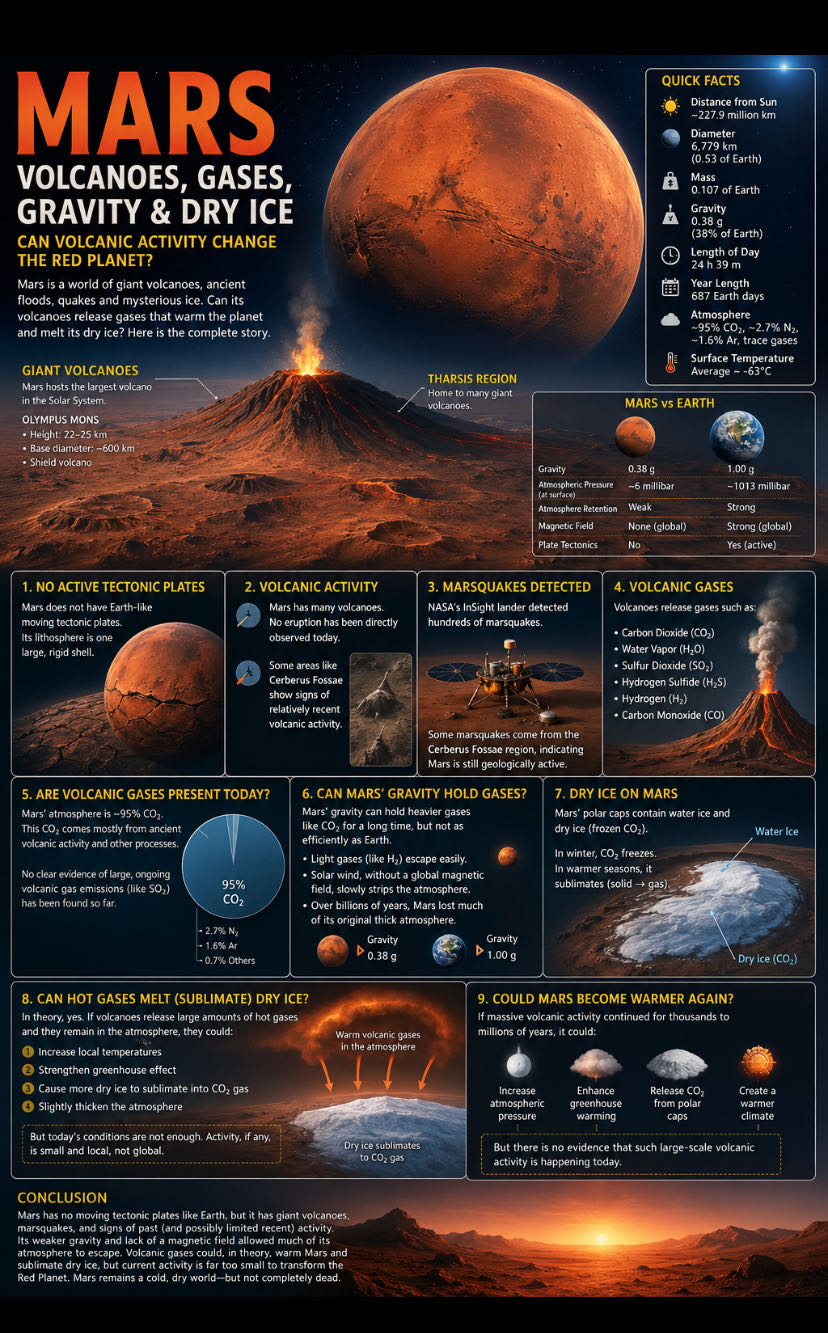
Here’s a simplified version using easy English while keeping the key scientific points.
Mars: Can Volcanoes, Gravity, and Dry Ice Change the Red Planet?
Mars is one of the most interesting planets in our Solar System. It has giant volcanoes, deep valleys, polar ice caps, and even marsquakes. But unlike Earth, Mars does not have moving tectonic plates, and its atmosphere is very thin.
No Moving Tectonic Plates
Earth’s surface is made of moving tectonic plates. These plates cause earthquakes and volcanic eruptions. Mars does not have this system. Its outer rocky layer is mostly one large, solid shell.
Giant Volcanoes
Mars has some of the biggest volcanoes ever discovered. The largest is Olympus Mons, which is about 22–25 km high and 600 km wide. Many other huge volcanoes are found in the Tharsis region.
Is Mars Still Active?
Scientists have never seen a volcanic eruption on Mars. However, NASA’s InSight mission detected hundreds of marsquakes, showing that the inside of Mars is still active. Some areas, such as Cerberus Fossae, may have had volcanic activity in the recent geological past.
Volcanic Gases
When volcanoes erupt, they can release gases such as:
* Carbon dioxide (CO₂)
* Water vapor (H₂O)
* Sulfur dioxide (SO₂)
* Hydrogen (H₂)
* Hydrogen sulfide (H₂S)
* Carbon monoxide (CO)
Scientists believe ancient volcanoes released these gases and helped create Mars’ early atmosphere.
Can Mars Hold These Gases?
Mars has only 38% of Earth’s gravity, so it can hold heavy gases like carbon dioxide for some time. But because Mars has no strong global magnetic field, the solar wind slowly removes its atmosphere into space.
Why Is Mars’ Atmosphere Thin?
Mars lost most of its atmosphere because:
* It has weaker gravity than Earth.
* It has no global magnetic field.
* Solar wind removes gases into space.
* Volcanoes are no longer adding large amounts of new gases.
What Is Dry Ice on Mars?
Mars’ polar caps contain:
* Water ice
* Frozen carbon dioxide (dry ice)
In winter, carbon dioxide freezes at the poles. In warmer seasons, it changes directly from solid to gas. This process is called sublimation.
Can Volcanoes Warm Mars?
If very large volcanoes released hot gases for a long time, they could:
* Warm the atmosphere.
* Increase the greenhouse effect.
* Turn more dry ice into carbon dioxide gas.
* Make the atmosphere a little thicker.
However, scientists have no evidence that such large volcanic eruptions are happening on Mars today.
Conclusion
Mars is not as active as Earth, but it is not completely dead. It has giant volcanoes, marsquakes, and signs of ancient volcanic activity. Although volcanic gases could, in theory, make Mars warmer, today’s activity is far too small to change the planet into an Earth-like world. Mars remains a cold, dry planet that still holds many secrets about its past.


Comments
No comments yet.