

Ownmates Post

Troy and the Trojan War: History, Archaeology, and Legend
The Trojan War is one of the most famous stories from ancient history and Greek mythology. According to tradition, it was fought between the Greek city-states and the city of Troy. Although the story has inspired countless books, films, and works of art, historians continue to debate how much of it is historical fact and how much is legend.
Where Was Troy?
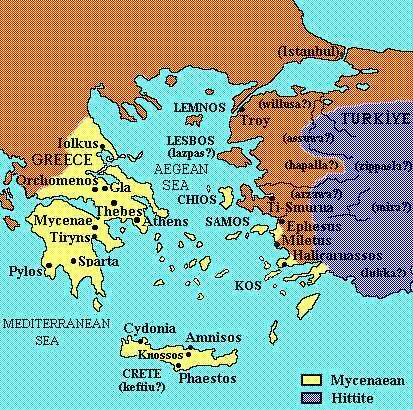
Troy was an ancient city located in what is now northwestern Türkiye (Turkey), near the Dardanelles Strait, an important waterway connecting the Aegean Sea to the Sea of Marmara. This location made Troy strategically valuable because it controlled major trade and shipping routes between Europe and Asia.
Today, the ruins of Troy are preserved as the Archaeological Site of Troy, a UNESCO World Heritage Site, near the village of Hisarlık in Çanakkale Province.
It is important to note that Troy was not a country. It was an independent city-state, much like Sparta, Athens, and other ancient Greek city-states.
* Sparta = (city Sparti) Modern Greece (Europe)
* Troy = (City Çanakkale )Modern Türkiye (Asia)
When Did the Trojan War Take Place?
If the Trojan War was based on a real historical event, most historians believe it likely occurred around 1200–1180 BC, more than 3,200 years ago.
Several centuries later, around the 8th century BC, the Greek poet Homer composed the epic poems Iliad and Odyssey. These works describe the final year of the Trojan War and the long journey home of the Greek hero Odysseus.
Because Homer wrote hundreds of years after the events he described, historians believe his poems combined oral traditions, history, and mythology.
What Is the Story of the Trojan War?
According to Greek mythology, the war began when Paris, a prince of Troy, took Helen, the wife of Menelaus, King of Sparta, to Troy. Some versions say Helen was abducted, while others suggest she willingly went with Paris.
Menelaus asked the Greek kings for help. His brother Agamemnon assembled a large Greek army, which sailed across the Aegean Sea and besieged Troy.
The war is said to have lasted ten years.
Many famous legendary heroes appear in the story, including:
* Achilles
* Hector
* Odysseus
* Ajax
* Paris
* Helen
According to the legend, the Greeks finally captured Troy by hiding soldiers inside a giant wooden horse, known today as the Trojan Horse. After the horse was brought into the city, the hidden soldiers emerged at night, opened the city gates, and allowed the Greek army to enter and destroy Troy.
Archaeological Evidence
Although many legendary details remain unproven, archaeology has shown that Troy was a real city.
Discovery of Troy
In the 1870s, German archaeologist Heinrich Schliemann began excavating the site at Hisarlık in Türkiye.
His excavations revealed that Troy had been rebuilt many times over thousands of years. Archaeologists identified multiple layers of ancient cities, each representing a different period of occupation.
One of these layers dates to approximately 1200 BC, the period traditionally associated with the Trojan War.
Evidence of Destruction
Archaeologists discovered evidence suggesting that one phase of the city experienced a violent end, including:
* Burned buildings
* Damaged defensive walls
* Weapons and arrowheads
* Signs of sudden destruction
These findings indicate that Troy likely suffered either a major war, an invasion, or another catastrophic event.
However, archaeology cannot determine whether this destruction corresponds exactly to the Trojan War described by Homer.
Hittite Records
Ancient documents from the Hittite Empire mention a kingdom called Wilusa.
Many scholars believe that Wilusa may be the same place known in Greek as Ilios, another name for Troy.
These records describe political tensions and conflicts in western Anatolia during the Late Bronze Age, suggesting that warfare in the region was historically possible.
Although this does not prove Homer’s story, it supports the idea that real conflicts occurred in the area.
Homer’s Iliad and Odyssey
The two great Greek epics remain the primary literary sources for the Trojan War.
Iliad
The Iliad focuses on only a few weeks during the final year of the war, especially the conflict between Achilles and Agamemnon.
Odyssey
The Odyssey tells the story of Odysseus, who spent another ten years trying to return home after the war, facing monsters, storms, gods, and magical creatures along the way.
These works are considered masterpieces of world literature but are not treated as straightforward historical records.
What Has Been Confirmed?
Historians generally agree on the following:
* Troy was a real ancient city.
* It occupied a strategically important location.
* The city experienced destruction around 1200 BC.
* Ancient conflicts occurred in western Anatolia during that period.
What Has Not Been Proven?
There is no direct historical evidence confirming:
* The existence of Helen as a historical person.
* Achilles, Odysseus, Paris, Hector, or other legendary heroes.
* The Trojan Horse as a real military strategy.
* That the war happened exactly as described by Homer.
Conclusion
Most historians believe that the story of the Trojan War was likely inspired by one or more real conflicts that took place around 1200 BC between powerful kingdoms in the eastern Mediterranean. Archaeological discoveries confirm that Troy existed and suffered destruction during that era.
However, the famous characters, dramatic battles, divine interventions, and the legendary Trojan Horse remain part of mythology and epic literature rather than established historical fact. For this reason, the Trojan War is best understood as a blend of history, archaeology, oral tradition, and myth—a story that has fascinated people for more than three thousand years.


Comments
No comments yet.