

Ownmates Post
Human Evolution : Genetic Change, and Why People Around the World Look Different
Introduction
People around the world differ in skin color, facial features, hair texture, eye shape, body proportions, and height. Africans, Europeans, Asians, Aboriginal Australians, and Indigenous peoples of the Americas often have distinct physical characteristics.
This naturally raises important questions: Are these different human species? Did they evolve separately? Or are they the result of mixtures between different populations?
Modern science provides a clear answer: No.
All modern humans belong to a single species, Homo sapiens. The physical differences we see today are primarily the result of migration, genetic variation, natural selection, genetic drift, founder effects, and adaptation to different environments over the past 60,000–70,000 years.
⸻
The Origin of Modern Humans
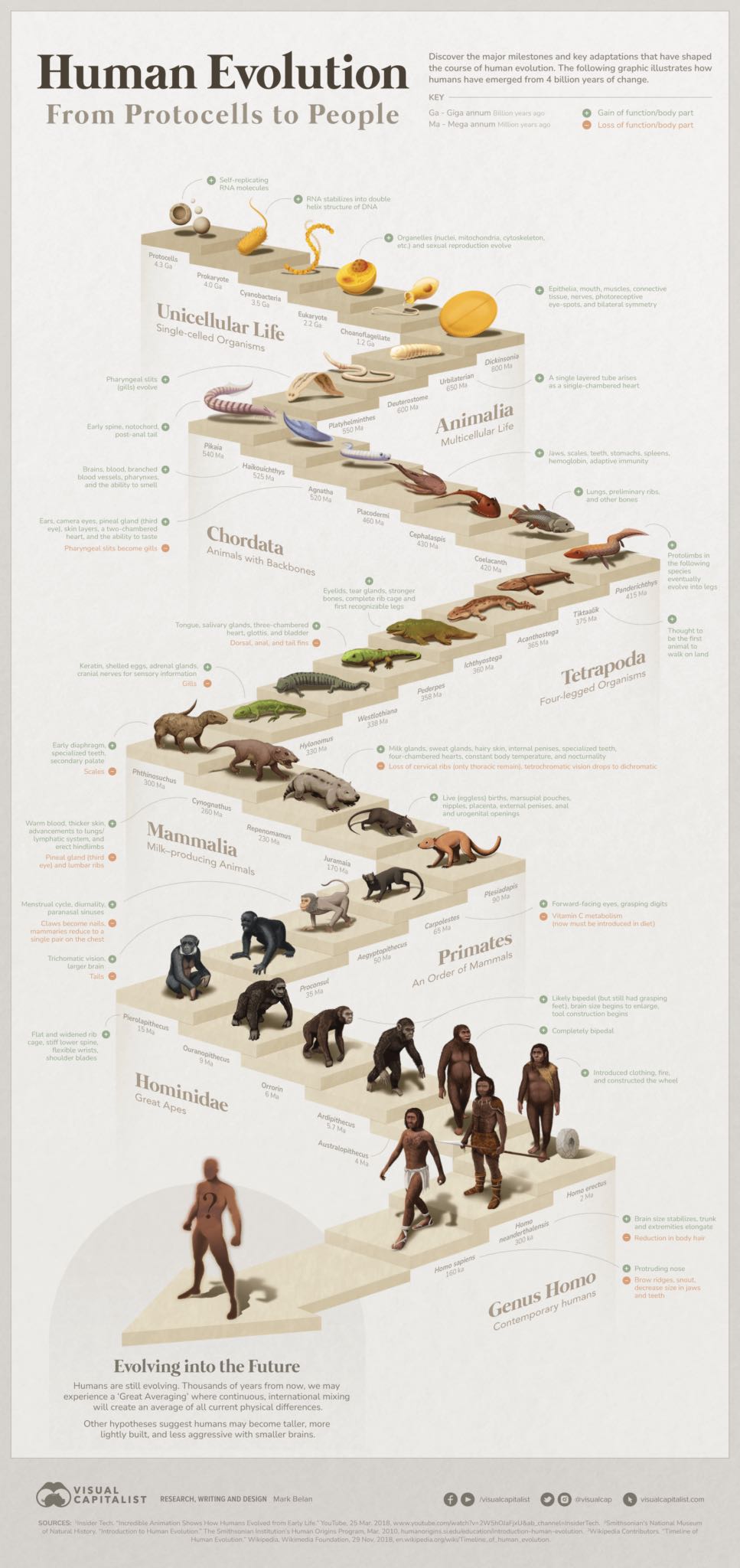
According to scientific evidence, Homo sapiens first evolved in Africa approximately 300,000 years ago.
At that time, several other human species also existed, including:
* Neanderthals
* Denisovans
* Homo erectus
Over time, however, only Homo sapiens survived and became the only remaining human species.
⸻
The Journey Out of Africa
Around 60,000–70,000 years ago, groups of modern humans began migrating out of Africa.
Over thousands of years they spread into:
* The Middle East
* Asia
* Europe
* Australia
* Eventually North and South America
This migration occurred gradually over many generations.
⸻
How Did Indigenous Peoples Reach the Americas?
During the last Ice Age, sea levels were much lower than they are today.
A land bridge known as Beringia (the Bering Land Bridge) connected Siberia and Alaska.
Between 20,000 and 15,000 years ago, groups of humans crossed this land bridge into North America.
Over thousands of years, they spread throughout North and South America.
Their descendants eventually developed into many Indigenous civilizations and cultures, including:
* Aztec
* Maya
* Inca
* Inuit
* Apache
* Navajo
* Cherokee
* Hundreds of other Indigenous nations
⸻
What Does “Indigenous” Mean?
The word Indigenous simply means:
The original or native inhabitants of a particular region.
It does not mean a separate human species.
Indigenous peoples are fully modern humans (Homo sapiens).
⸻
Why Do Human Faces Look Different?
If all humans belong to the same species, why do people look different?
The answer lies in human evolution.
⸻
1. Genetic Mutations
Every generation experiences small natural changes in DNA called mutations.
Most mutations:
* Have no noticeable effect.
* Some are harmful.
* A very small number may be beneficial.
⸻
2. Natural Selection
Traits that improve survival or reproduction in a particular environment tend to become more common over many generations.
For example:
In regions with intense ultraviolet (UV) radiation, darker skin provides better protection against UV damage. Over thousands of years, darker skin became more common in many African populations.
⸻
3. Genetic Drift
Sometimes traits become common simply because of chance, especially in relatively small populations.
This random process is known as genetic drift.
⸻
4. Founder Effect
When a small group separates from a larger population and establishes a new community, the genetic characteristics of that small founding group may become common among its descendants.
This phenomenon is called the founder effect.
⸻
5. Long-Term Geographic Isolation
When human populations remain separated for thousands of years with limited interbreeding, their genetic differences gradually increase.
As a result, average physical characteristics became somewhat different among populations in:
* Africa
* Europe
* East Asia
* South Asia
* Australia
* The Americas
⸻
Does Environment Alone Change Human Faces?
No.
Facial appearance is influenced by several interacting factors:
* Genetics
* Natural selection
* Genetic drift
* Founder effects
* Long-term population isolation
These processes work together over many generations.
⸻
Is Human Evolution Still Happening Today?
Yes.
Human evolution has not stopped.
New genetic mutations occur in every generation.
Examples include:
* Lactase persistence, allowing many adults to digest milk.
* Genetic adaptations that help Tibetan populations live at high altitudes with low oxygen.
* Genetic variants that provide partial protection against malaria in certain populations.
These adaptations have developed relatively recently in human history.
⸻
Does Evolution Change an Individual During Their Lifetime?
No.
Evolution does not change a person’s face or body during their lifetime.
Instead, evolution occurs across entire populations over many generations through changes in the frequencies of genetic variants.
⸻
Will Humans Continue to Evolve?
Yes.
If human populations remain isolated in different environments for many thousands—or even millions—of years, natural selection and other evolutionary processes could continue to produce new physical adaptations.
However, today’s world is highly interconnected. Global travel and intermarriage between populations increase genetic mixing, making human populations more genetically connected than at most times in the past.
⸻
In short:
All modern humans belong to the same biological species, Homo sapiens. The differences seen among Africans, Europeans, Asians, Aboriginal Australians, and Indigenous peoples of the Americas do not indicate different human species.
Instead, these differences are the result of migration, genetic variation, natural selection, genetic drift, founder effects, and long-term adaptation to different environments over thousands of years.
Human evolution is still ongoing today, but it is an extremely slow process. Major evolutionary changes become visible only across many generations and long periods of time, not within the lifetime of an individual.


Comments
No comments yet.