

Ownmates Post
The Critical Truth About the “Golden Age” of the Gupta Period (Detailed Analysis)
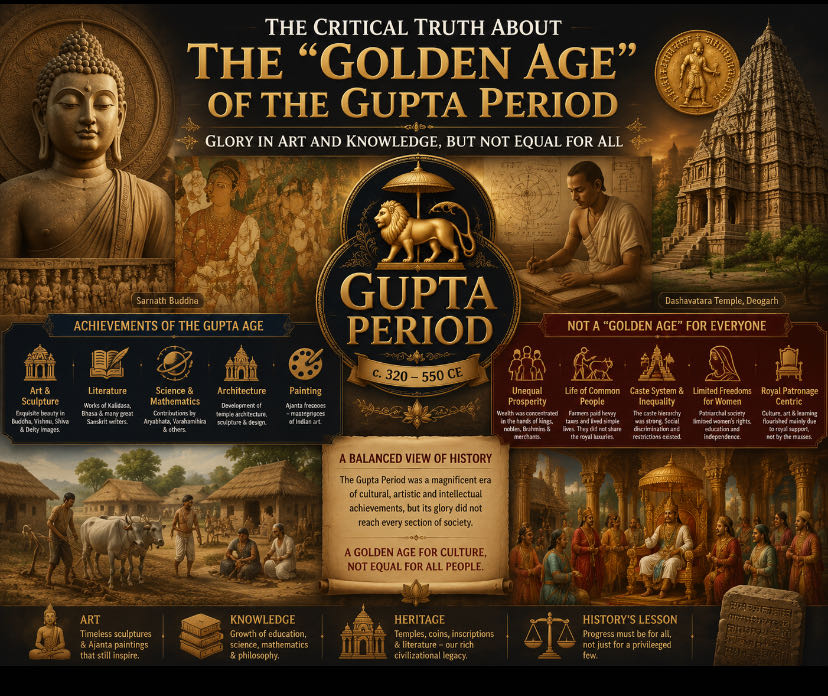
The Gupta Period (c. 320–550 CE) is often called the “Golden Age of India” because of remarkable achievements in art, literature, science, mathematics, astronomy, architecture, and philosophy. However, modern historians argue that this term has limitations. They point out that the period was a golden age mainly for royal courts, scholars, and elite culture, while the experiences of ordinary people were more complex.
⸻
1. Prosperity Was Not Equally Distributed Across Society
During the Gupta period, agriculture, trade, education, and artistic activities expanded. Large temples, learning centers, and cultural institutions developed.
However, this prosperity was mainly concentrated among:
* Kings and royal families
* Land-owning elites
* Brahmins and scholars
* Wealthy merchants
The majority of the population consisted of farmers and laborers whose lives were very different from those of the ruling class.
Condition of Farmers
Agriculture was the foundation of the Gupta economy.
* Most people depended on farming for survival.
* Farmers paid taxes to the state.
* Land grants became common, especially grants given to Brahmins and religious institutions.
* In some regions, these land grants created new systems of authority over villages and agricultural workers.
Therefore, the achievements of Gupta culture were also supported by the hard work of ordinary rural communities.
⸻
2. The Life of Common People Was Different From the Elite Class
Most historical sources from the Gupta period come from:
* Royal inscriptions
* Sanskrit literature
* Religious texts
* Temple records
These sources often describe the lives of kings, priests, and educated elites rather than ordinary people.
Daily Life of Common People
* Farmers generally lived simple lives based on agriculture.
* Food mainly consisted of grains, pulses, vegetables, and locally available products.
* Expensive clothing, jewelry, luxury goods, and entertainment were mostly enjoyed by wealthy groups.
Education
Education was not equally available to everyone.
* Sanskrit education was largely connected with elite groups and religious scholars.
* Universities and learning centers developed, but access was limited.
* Many ordinary people remained outside formal educational systems.
⸻
3. Caste System and Social Inequality
During the Gupta period, the social hierarchy based on varna and caste became more established.
The traditional four-varna system included:
1. Brahmins – priests, scholars, and religious authorities
2. Kshatriyas – rulers and warriors
3. Vaishyas – traders and agricultural communities
4. Shudras – service and labor groups
However, actual society was much more complex, with many different communities and occupational groups.
Rise of Brahmin Influence
* Brahmins received land grants from rulers.
* Their religious and social influence increased.
* Sanskrit culture received strong royal support.
Marginalized Groups
* Many lower social groups faced restrictions and discrimination.
* Social mobility was limited.
* Equal opportunities were not available to all sections of society.
⸻
4. Status of Women
The position of women during the Gupta period was complex.
Some women, especially from royal and wealthy families:
* Participated in cultural and religious activities.
* Had influence in certain social and political matters.
However, many women faced limitations:
* Patriarchal traditions were strong.
* Women’s property and social rights were often restricted.
* Marriage customs reduced independence in many communities.
Historians study women’s status through different sources, and conditions varied by region and social class.
⸻
5. Limitations of the Term “Golden Age”
The Gupta period is called a Golden Age because:
✅ Kalidasa produced great Sanskrit literature.
✅ Aryabhata made major contributions to mathematics and astronomy.
✅ Indian science and philosophy advanced.
✅ Sculpture, painting, and temple architecture reached high levels.
✅ Sanskrit literature and classical culture flourished.
But from a critical historical perspective:
❌ It was not a period of equal prosperity for everyone.
❌ Ordinary farmers and laborers did not experience the same privileges as elites.
❌ Social inequalities continued.
❌ Political power remained concentrated among ruling groups.
⸻
6. Balanced Historical View
Modern historians generally describe the Gupta period as:
“A golden age of Indian art, literature, science, and intellectual achievements — but not necessarily a golden age for every section of society.”
In simple terms:
Cultural and intellectual achievements → Golden Age
Social equality and living conditions of all people → A more complicated picture
The true history of the Gupta period includes both its extraordinary achievements and its social inequalities.


Comments
No comments yet.