

Ownmates Post

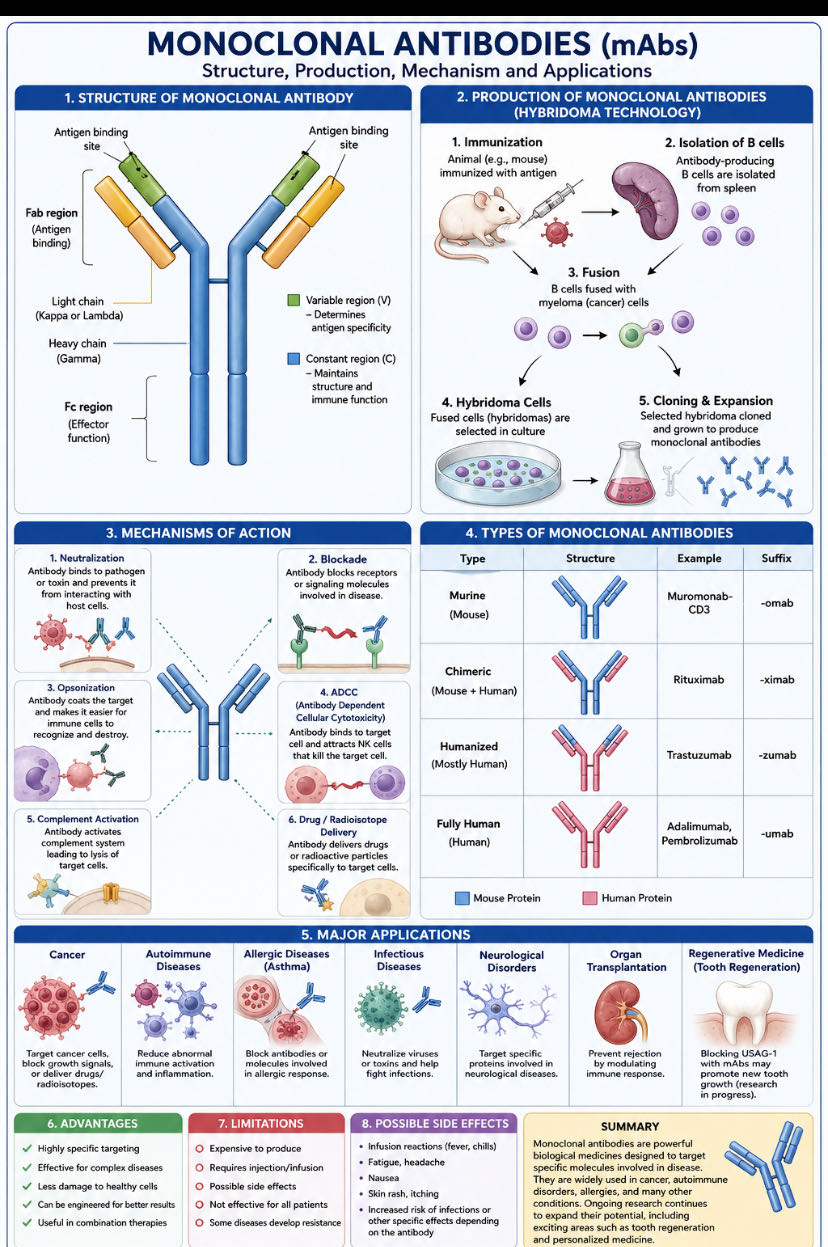
Monoclonal Antibodies (mAbs): Important Notes
1. Definition
* Monoclonal antibodies (mAbs) are laboratory-made proteins.
* They are designed to recognize and bind to one specific antigen (target).
* They are an important part of precision medicine.
⸻
2. What Are Antibodies?
* Antibodies are Y-shaped proteins.
* Produced by B lymphocytes (B cells).
* Also called Immunoglobulins (Ig).
* Protect the body against:
* Viruses
* Bacteria
* Fungi
* Parasites
* Toxins
* Cancer cells
⸻
3. Monoclonal vs. Polyclonal Antibodies
Polyclonal Antibodies
* Produced naturally by the immune system.
* Recognize many different epitopes on an antigen.
Monoclonal Antibodies
* Produced from one clone of B cells.
* All antibodies are identical.
* Recognize only one specific epitope.
⸻
4. History
* Developed in 1975.
* Scientists:
* Georges Köhler
* César Milstein
* Niels Kaj Jerne
* Technology: Hybridoma Technology
* Awarded the 1984 Nobel Prize in Physiology or Medicine.
⸻
5. Structure
A monoclonal antibody has a Y-shaped structure.
Main parts:
* Two Heavy Chains
* Two Light Chains
* Fab Region – Binds to the antigen.
* Fc Region – Activates immune responses.
⸻
6. Traditional Production (Hybridoma Technology)
1. Mouse is immunized with an antigen.
2. B cells are collected from the spleen.
3. B cells are fused with myeloma (cancer) cells.
4. Hybridoma cells are formed.
5. Best hybridoma is selected.
6. Large amounts of identical antibodies are produced.
⸻
7. Modern Production Technologies
* Recombinant DNA technology
* Genetic engineering
* CHO (Chinese Hamster Ovary) cell culture
* Humanized antibody technology
* Fully human antibody platforms
* Phage display technology
⸻
8. Types of Monoclonal Antibodies
Murine (-omab)
* 100% mouse protein
* Example: Muromonab-CD3
* Highest risk of immune reaction
Chimeric (-ximab)
* Mouse Human
* Example: Rituximab
Humanized (-zumab)
* Mostly human protein
* Example: Trastuzumab
Fully Human (-umab)
* Completely human
* Examples:
* Adalimumab
* Pembrolizumab
* Lowest risk of immune rejection
⸻
9. Mechanisms of Action
Monoclonal antibodies work by:
* Blocking receptors
* Neutralizing viruses and toxins
* Activating immune cells
* Delivering chemotherapy drugs
* Delivering radioactive particles
* Blocking immune checkpoints to help fight cancer
⸻
10. Medical Applications
Cancer
* Breast cancer
* Lung cancer
* Leukemia
* Lymphoma
* Melanoma
* Colorectal cancer
Autoimmune Diseases
* Rheumatoid arthritis
* Psoriasis
* Crohn’s disease
* Ulcerative colitis
* Ankylosing spondylitis
Other Uses
* Severe asthma
* Allergic diseases
* Infectious diseases
* Alzheimer’s disease
* Migraine
* Organ transplantation
* Experimental tooth regeneration
⸻
11. Tooth Regeneration
* Targets USAG-1 protein.
* Blocking USAG-1 may activate tooth development.
* Successful in animal studies.
* Human clinical trials are ongoing.
* Not yet an approved treatment.
⸻
12. Advantages
* Highly specific
* Precision treatment
* Less damage to healthy cells
* Effective against many serious diseases
* Can be combined with other therapies
⸻
13. Limitations
* Expensive
* Usually given by injection or IV infusion
* Not effective in everyone
* Some diseases develop resistance
* Requires refrigerated storage
* Complex manufacturing process
⸻
14. Common Side Effects
* Infusion reactions
* Fever
* Chills
* Headache
* Fatigue
* Skin rash
* Allergic reactions
* Increased risk of infection (for some therapies)
⸻
15. Future Directions
Scientists are developing monoclonal antibodies for:
* Personalized cancer therapy
* Autoimmune diseases
* Regenerative medicine
* Tooth regeneration
* Gene-targeted therapy
* Bispecific antibodies
* Antibody-drug conjugates (ADCs)
* AI-designed antibodies
⸻
Key Facts to Remember
* mAbs = Monoclonal Antibodies
* Ig = Immunoglobulin
* Produced by = B cells
* Shape = Y-shaped
* Technology = Hybridoma Technology
* First developed = 1975
* Nobel Prize = 1984
* Fab = Antigen-binding region
* Fc = Immune-activating region
* Murine = -omab
* Chimeric = -ximab
* Humanized = -zumab
* Fully Human = -umab
* Experimental Tooth Regeneration Target = USAG-1
* Major Uses = Cancer, autoimmune diseases, allergies, infectious diseases, organ transplantation, regenerative medicine


Comments
No comments yet.