

Ownmates Post
I’ve converted it into a polished English article:
The Language ‘s Journey from Ancient Times to the Future
Language is one of the most important inventions of human civilization. It is not only a tool for communication but also a medium for transferring culture, knowledge, and ideas from one generation to another. Over time, languages change, evolve, and adapt according to new circumstances. If we observe the journey of language from ancient times to the future, it becomes a fascinating story of continuous transformation.
Ancient Times: The Beginning with Sounds and Gestures
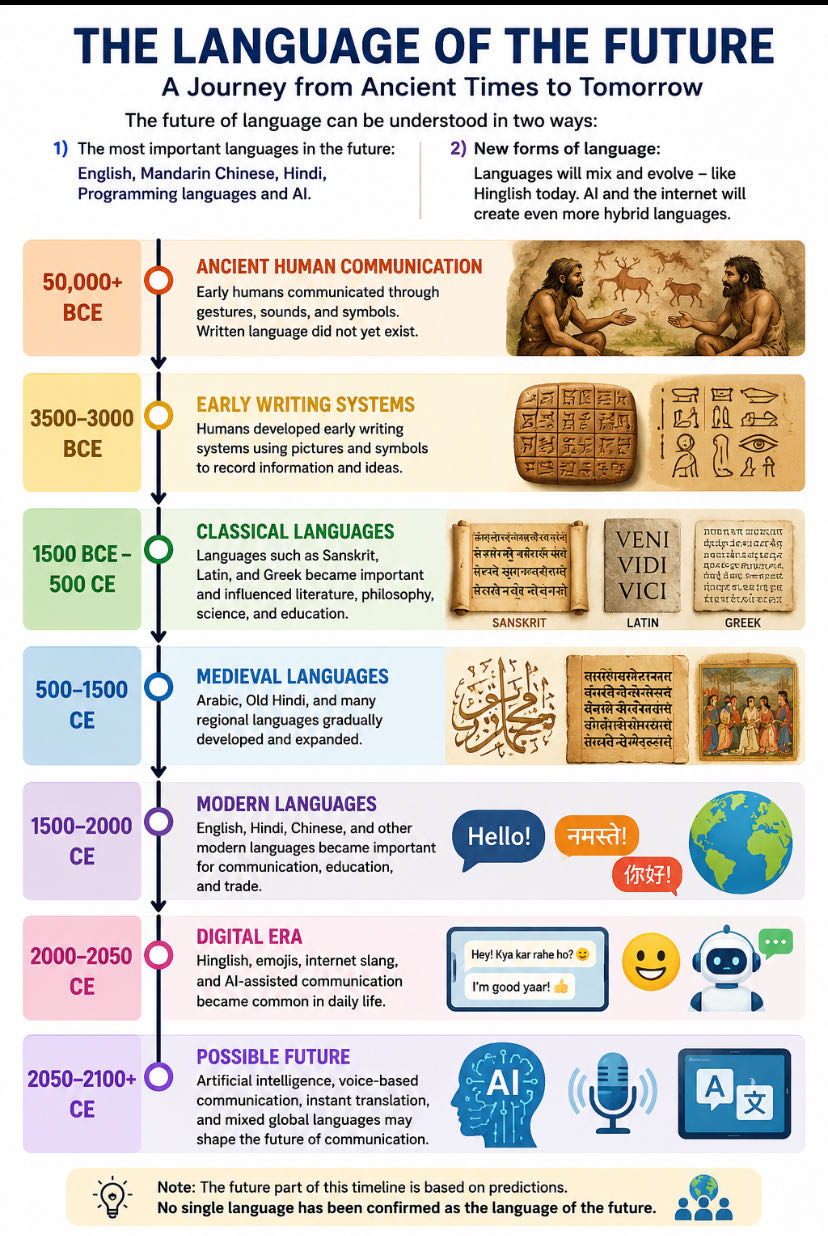
Around 50,000 years ago, early humans communicated through gestures, sounds, and symbols. At that time, written language did not exist. People used simple vocal expressions and signs to communicate emotions and basic needs.
The Rise of Early Writing Systems
Around 3500–3000 BCE, humans developed early writing systems. Ideas and information started being recorded through symbols and pictorial forms. This marked a major turning point in human history because knowledge could now be preserved and passed on.
The Era of Classical Languages
Between 1500 BCE and 500 CE, classical languages such as Sanskrit, Latin, and Greek became prominent. These languages played an important role in the development of literature, philosophy, science, and education. Their influence can still be seen in many modern languages today.
The Development of Medieval Languages
From 500 CE to 1500 CE, many regional languages began to evolve. Arabic, Old Hindi, and other regional languages gradually developed and spread. During this period, language became more deeply connected with culture and society.
The Age of Modern Languages
Between 1500 and 2000, modern languages expanded rapidly. English, Hindi, Chinese, and many other languages became important for education, trade, and international communication. Technological progress and globalization accelerated the spread of these languages.
The Digital Era and Changing Language Patterns
The period from 2000 to 2050 can be seen as the digital era. The internet, social media, and artificial intelligence have transformed the way people use language. Today, people frequently use Hinglish, emojis, internet slang, and short digital expressions.
What Could the Language of the Future Look Like?
It is difficult to predict exactly what the language of the future will be, but some possibilities are becoming clear. English may continue to play a major role in global communication, while languages such as Hindi and Mandarin Chinese may remain influential because of their large speaker populations. In addition, artificial intelligence and technology may create new blended forms of communication.
In the future, people may rely more on voice-based technology, instant translation systems, and AI-powered communication tools. Languages could become more simplified, interconnected, and global in nature.
Conclusion
The journey of language has progressed from ancient gestures and sounds to modern digital communication, and it will continue to evolve in the future. Human society will keep changing, and language will adapt along with it. The language of the future may not simply be a collection of words; it could represent a combination of technology, human creativity, and global connection.


Comments
No comments yet.