

Ownmates Post

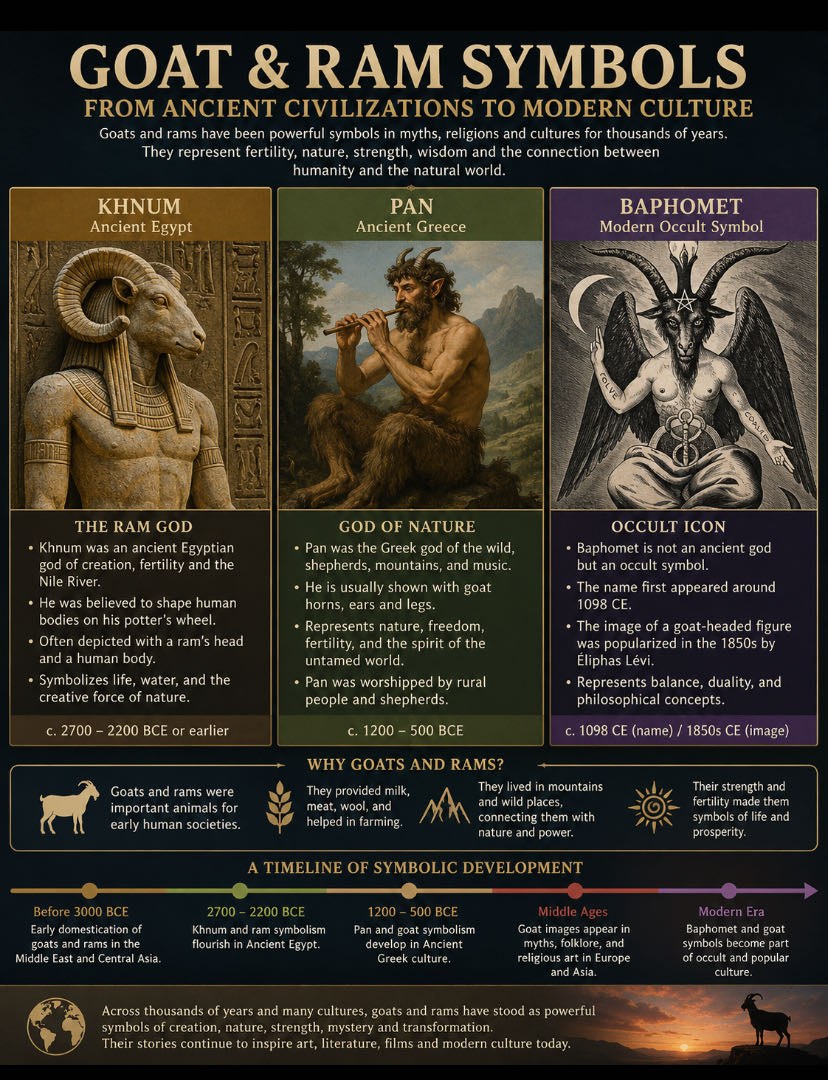
Goat and Ram Symbols: From Ancient Civilizations to Modern Culture
Throughout the early history of human civilization, animals played a central role in daily life, culture, and religion. Animals that people depended on for food, clothing, farming, and transportation gradually became important cultural and religious symbols. Among these animals, goats and rams occupied a special place in human imagination and belief systems for thousands of years.
In ancient Egypt, the ram was often associated with strength, creation, and fertility. Religious art and sculptures frequently depicted deities with ram features, symbolizing life, prosperity, and the natural forces that sustained civilization. Since the Nile River was the foundation of Egyptian society, symbols connected with nature and fertility held great importance.
In ancient Greek traditions, goats were closely linked to mountain life, shepherds, and the wilderness. Mythological figures connected with forests, music, and pastoral life were often portrayed with goat-like features such as horns or legs. These symbols represented humanity’s connection with nature, celebration, creativity, and rural traditions.
During the medieval and modern periods, the image of the goat acquired new meanings in various mystical and esoteric traditions. Goat-headed figures and symbols were sometimes used to express philosophical ideas or symbolic concepts rather than objects of worship. Over time, literature, art, and popular culture introduced new interpretations and meanings to these images.
Historians generally believe that the importance of goats and rams in different cultures developed because of their practical value in human life. For pastoral societies, these animals were not merely livestock; they represented wealth, survival, and prosperity.
It is important to recognize that symbols that appear similar across cultures do not necessarily carry the same meaning. A figure representing fertility and creation in one civilization may symbolize nature, power, or philosophical ideas in another.
Even today, the influence of these ancient symbols can be found in films, literature, painting, video games, and popular culture around the world. They remind us that human societies have long used stories and symbols to understand the world around them and to give meaning to life and nature.
The history of goat and ram symbolism is therefore more than a religious story. It is also a reflection of humanity’s long journey of imagination, culture, and civilization, showing how different societies interpreted the natural world and their place within it.


Comments
No comments yet.