

Ownmates Post

In today’s world, Artificial Intelligence (AI) and digital technology are growing rapidly. AI is no longer limited to one or two areas; it is now being used in almost every sector. It plays an important role in offices, businesses, government services, education, healthcare, agriculture, finance, transportation, and social media.
In the field of education, online classes and online examinations have completely changed the way people learn. Students can study from home using the internet, mobile phones, computers, and other digital devices. AI-based systems also help in personalizing learning according to students’ abilities and performance.
However, with the rapid growth of the digital world, new environmental impacts are also emerging. Online classes, online examination centers, cloud services, and internet platforms depend on large data servers and data centers. These servers require a continuous supply of electricity and powerful cooling systems for their operation.
Millions of data centers around the world operate day and night. Running these systems requires a large amount of energy. If this energy comes from coal, oil, or other fossil fuels, it can increase the emission of carbon dioxide and other greenhouse gases.
In addition, digital devices such as mobile phones, computers, and servers require various minerals and natural resources for manufacturing. To obtain these resources, large-scale mining activities and sometimes deforestation take place. Excessive mining can lead to land degradation, deforestation, environmental pollution, and an increase in temperature.
The greenhouse effect is a natural process in which the Earth’s atmosphere traps heat from the Sun and keeps the planet warm enough for life to exist. However, when the amount of greenhouse gases such as carbon dioxide and methane increases, more heat becomes trapped in the atmosphere. This leads to global warming.
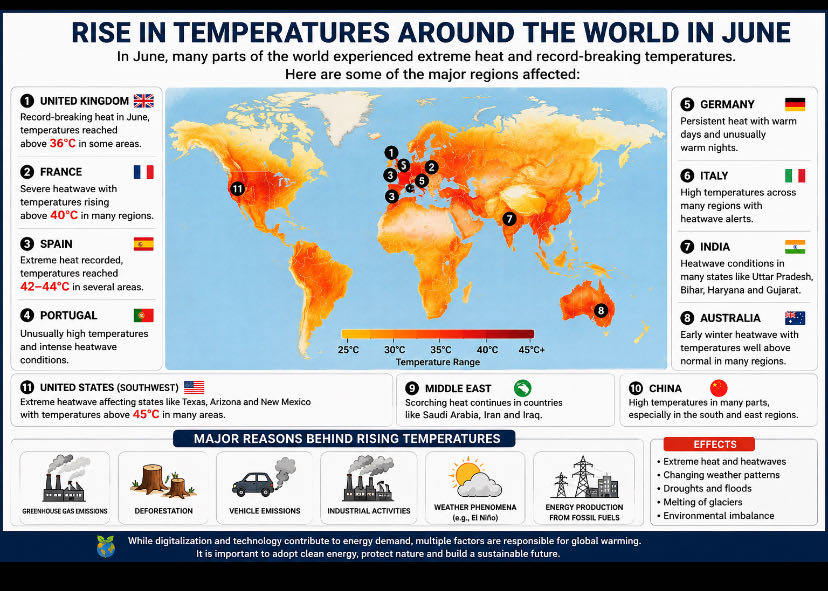
Today, the effects of rising temperatures can already be seen in many parts of the world through extreme heat during summers, changing weather patterns, floods, droughts, and environmental imbalance. However, digitalization alone is not responsible for these problems. Industrial activities, vehicle emissions, deforestation, energy production, and many other human activities also contribute significantly.
In conclusion, technology and AI are making human life easier and more efficient, but it is equally important to understand their environmental impact. We should encourage the use of cleaner technologies, renewable energy sources, and sustainable resource management to maintain a balance between development and environmental protection.


Comments
High alert