

Ownmates Post

Who are the Yazidis?
The Yazidis are an ancient religious and cultural community, primarily based in northern Iraq. Below is a concise overview based on the information you provided, with some additional context:
Origin and Location
• Primary Location: Northern Iraq (especially Sinjar region).
• Other Communities: Found in Syria, Turkey, Armenia, Georgia, and Germany (due to migration).
• Population: Approximately 500,000–1 million (as of 2020), with many seeking refuge in Europe, particularly Germany.
Yazidi Religion
• Name: Yazidism, a monotheistic faith.
• Core Beliefs:
◦ One supreme God (Khuda) created the world and entrusted it to seven holy angels.
◦ Malak Taus (Peacock Angel) is the chief angel, revered as God’s holiest messenger.
• Sacred Texts: No formal written scriptures; traditions and hymns (Qewls) are passed down orally.
• Holy Site: Lalish, in Iraq, is the most sacred pilgrimage site for Yazidis.
Misconception: “Devil Worshippers”?
• Myth: Some mistakenly associate Malak Taus with Satan, labeling Yazidis as “devil worshippers.”
• Reality: Yazidis consider Malak Taus a divine and holy angel, not an evil entity. This misunderstanding has fueled centuries of persecution, including by ISIS.
2014 Yazidi Genocide
• Event: In 2014, ISIS attacked Sinjar, Iraq, targeting Yazidis:
◦ Thousands of Yazidi men were killed.
◦ Women and children were abducted and subjected to sexual slavery.
◦ Many were displaced, fleeing to refugee camps or abroad.
• Impact: The United Nations declared it a “genocide,” devastating the Yazidi community and scattering survivors globally.
Yazidis Today
• Culture and Traditions:
◦ Belief in reincarnation.
◦ Strict endogamy (marrying within the community); conversion to Yazidism is not allowed—membership is by birth only.
◦ Emphasis on religious and social separation to preserve identity.
• Challenges:
◦ Rebuilding after the genocide, including resettlement and trauma recovery.
◦ Preserving cultural identity, especially in diaspora.
• Key Site: Lalish remains the spiritual heart of Yazidism.
🏔️The Lalish Temple is the holiest site in Yazidism, a sacred destination that every Yazidi aspires to visit at least once in their lifetime for pilgrimage. Below is a detailed overview in English, based on your input, with additional context for clarity.
🕯️ Lalish Temple —
Description
📍 Location
Lalish Valley, Nineveh Province, Northern Iraq (near Mosul, Shekhan District)
⛰️ Geography
Situated in a serene, green mountainous region
🏛️ Religious Significance
The most sacred site in Yazidi religion
🔥 Eternal Flame
A perpetual lamp burns in the temple, symbolizing purity and divine presence
🧙♂️ Why is Lalish Considered Sacred?
1 🪶 Malak Taus (Peacock Angel):
◦ The supreme angel in Yazidism, believed to have descended to Earth at Lalish.
2 🧱 Sheikh Adi ibn Musafir:
◦ The temple is built over the tomb of Sheikh Adi, a 12th-century mystic revered as a Yazidi saint.
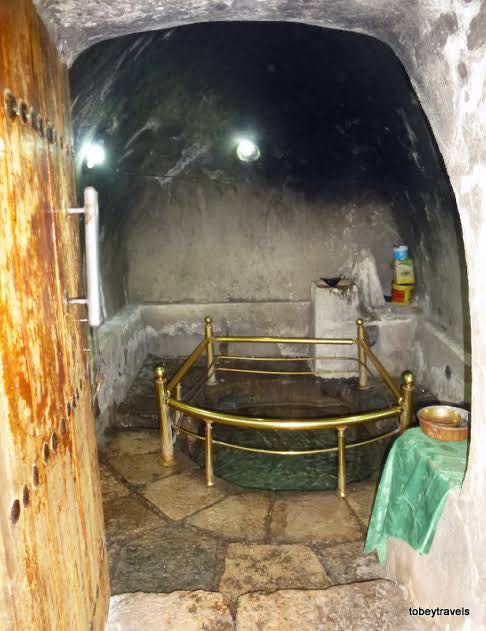
3 💧 Kaniya Spî (White Spring):
◦ A sacred spring within the temple where devotees perform ritual baths for spiritual purification.
🔔 Religious Practices
Ritual
Description
🚶♂️ Barefoot Entry
Shoes are prohibited in the temple complex to maintain its sanctity
🕯️ Lighting Lamps
Devotees light oil lamps as part of prayers
🧂 Offering Salt
Salt is offered as a symbol of unity and purity
💦 Holy Spring Bath
Bathing in the sacred White Spring is considered an act of spiritual cleansing
🌙 Annual Pilgrimage
The Jema’iyya Festival in September is the largest Yazidi festival
🏛️ Architectural Features
• Style: Built in traditional Kurdish stone architecture.
• Conical Domes: Distinctive cone-shaped domes on the temple’s roofs, a key Yazidi symbol.
• Interiors: Simple yet spiritually evocative, fostering a sacred atmosphere.
❗ Lalish and the ISIS Attacks
• 2014 ISIS Assault: During the 2014 genocide, when ISIS targeted Yazidi communities in Sinjar, the Lalish Temple fortunately remained unharmed.
• Protection: The temple’s location in a mountainous area and local efforts helped safeguard it, though other Yazidi sites were destroyed.
✅ Conclusion
The Lalish Temple is the spiritual heart of Yazidism—a serene, sacred, and historic site that embodies the essence of Yazidi faith, culture, and resilience. It remains a beacon of hope and identity for the Yazidi community amidst their historical struggles.
• Historical Roots: Yazidism likely draws from ancient Mesopotamian and Zoroastrian traditions but is a distinct religion.
• Current Efforts: International organizations and governments are aiding Yazidi rehabilitation, focusing on justice for genocide survivors and cultural preservation.


Comments
No comments yet.