

Ownmates Post
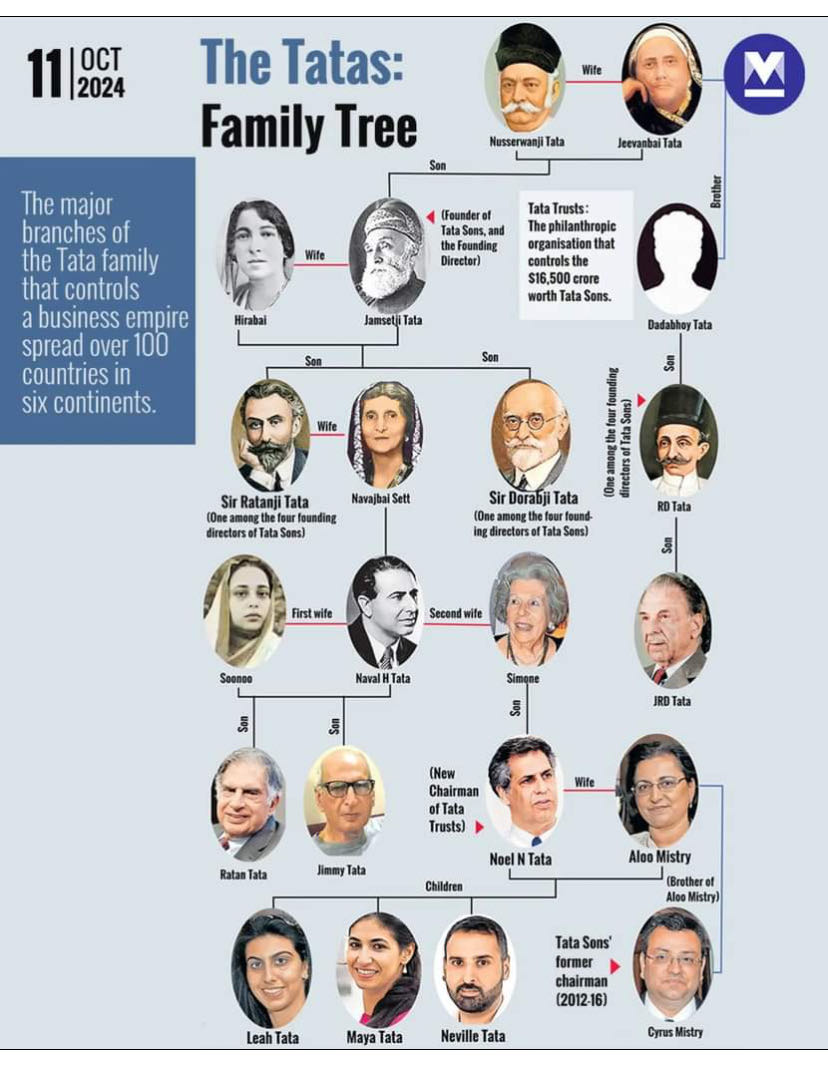
The Tata family is one of India’s oldest and most prestigious industrial families, with a legacy that began in the 19th century under the visionary leadership of Jamsetji Tata, the founder of the Tata Group. Below is a concise history of the Tata family and their rise to prominence:
1. Origins and Early Years
• Parsi Community: The Tata family belongs to the Parsi community, originally settled in Navsari, Gujarat. Parsis were known for their entrepreneurial spirit in the 19th century.
• Jamsetji Tata (1839–1904): The founder of the Tata empire, often called the “Father of Indian Industry.”
◦ Born: March 3, 1839, in Navsari, Gujarat, to a Parsi priest family.
◦ His father, Nusserwanji Tata, was a small-scale merchant.
◦ Jamsetji joined his father’s business at age 14 and later graduated from Elphinstone College, Mumbai, in 1858, before diving into trade.
2. Foundation of the Tata Group
• 1868: Jamsetji established Tata and Sons, initially a trading company.
• Textile Industry: In 1877, he founded the Empress Mills in Nagpur, one of India’s first modern textile mills, symbolizing the Swadeshi movement.
• Visionary Plans: Jamsetji envisioned ventures in steel, power, and education, laying the groundwork for:
1 A steel plant (later Tata Steel).
2 A hydroelectric power facility (Tata Power).
3 A world-class educational institute (Indian Institute of Science).
• Although he passed away in 1904 before realizing these dreams, his sons carried forward his vision.
3. Expansion of the Tata Group
• Dorabji Tata (1859–1932): Jamsetji’s elder son, who brought his father’s dreams to life.
◦ 1907: Founded Tata Steel (TISCO) in Jamshedpur, India’s first steel plant.
◦ 1910: Established Tata Power, a pioneer in hydroelectricity.
◦ Supported the creation of the Indian Institute of Science in Bangalore.
• Ratanji Tata (1871–1918): Jamsetji’s younger son, who strengthened the group’s business operations.
• The Tata Group played a pivotal role in India’s industrialization during British rule, challenging colonial dominance in trade.
4. J. R. D. Tata Era (1904–1993)
• Jehangir Ratanji Dadabhoy Tata: The leader who elevated the Tata Group to global prominence.
◦ Born: July 29, 1904, in Paris, France (son of Ratanji Tata).
◦ Became chairman of Tata Sons in 1938.
• Key Contributions:
◦ 1932: Founded Tata Airlines, which later became Air India, India’s first commercial airline.
◦ Expanded into chemicals (Tata Chemicals), automobiles (Tata Motors), and tea (Tetley).
◦ Pioneered employee welfare with pensions, health insurance, and better workplaces.
◦ Strengthened Tata Trusts, focusing on education, healthcare, and rural development.
• Recognition: Awarded the Bharat Ratna in 1992, India’s highest civilian honor.
5. Ratan Tata Era (1937–Present)
• Ratan Tata: Son of Naval Tata (adopted into the Tata family).
◦ Born: December 28, 1937, in Mumbai.
◦ Became chairman of Tata Sons in 1991.
• Key Contributions:
◦ Globalized the Tata Group through major acquisitions:
▪ 2000: Tetley Tea (world’s second-largest tea company).
▪ 2007: Corus Steel, making Tata Steel a global leader.
▪ 2008: Jaguar Land Rover, elevating Tata Motors in the luxury car market.
◦ Launched Tata Nano (2008), the world’s cheapest car, aimed at India’s middle class.
◦ Transformed Tata Consultancy Services (TCS) into a global IT giant.
• Social Impact: Expanded Tata Trusts’ work in cancer care, education, and rural development.
• Awards: Honored with Padma Bhushan (2000) and Padma Vibhushan (2008).
6. Key Characteristics of the Tata Family
• Ethical Business: The Tata Group is renowned for its ethical practices and social responsibility. Tata Trusts, holding 66percent of Tata Sons, is one of India’s largest philanthropic organizations.
• Swadeshi Spirit: The Tatas promoted indigenous industries during British rule, contributing to India’s self-reliance.
• Family Structure: The Tata family has multiple branches, all rooted in Parsi traditions. Ratan Tata, being unmarried and childless, has no direct heir, marking a shift in leadership to non-family members.
7. Current Status
• Noel Tata: Ratan Tata’s half-brother, active in Tata Group companies like Trent and Tata International.
• N. Chandrasekaran: Chairman of Tata Sons since 2017, the first non-Parsi and non-family chairman.
• The Tata Group today operates over 100 companies across automobiles, IT, steel, chemicals, and hospitality, with a presence in over 100 countries.
Conclusion
The Tata family’s history is intertwined with India’s economic and social progress. From Jamsetji Tata’s visionary foundation to J. R. D. Tata’s innovations and Ratan Tata’s global expansion, the family has built a legacy of trust, innovation, and nation-building. Their wealth is not just financial but also rooted in their commitment to India’s development.


Comments
No comments yet.