

Ownmates Post

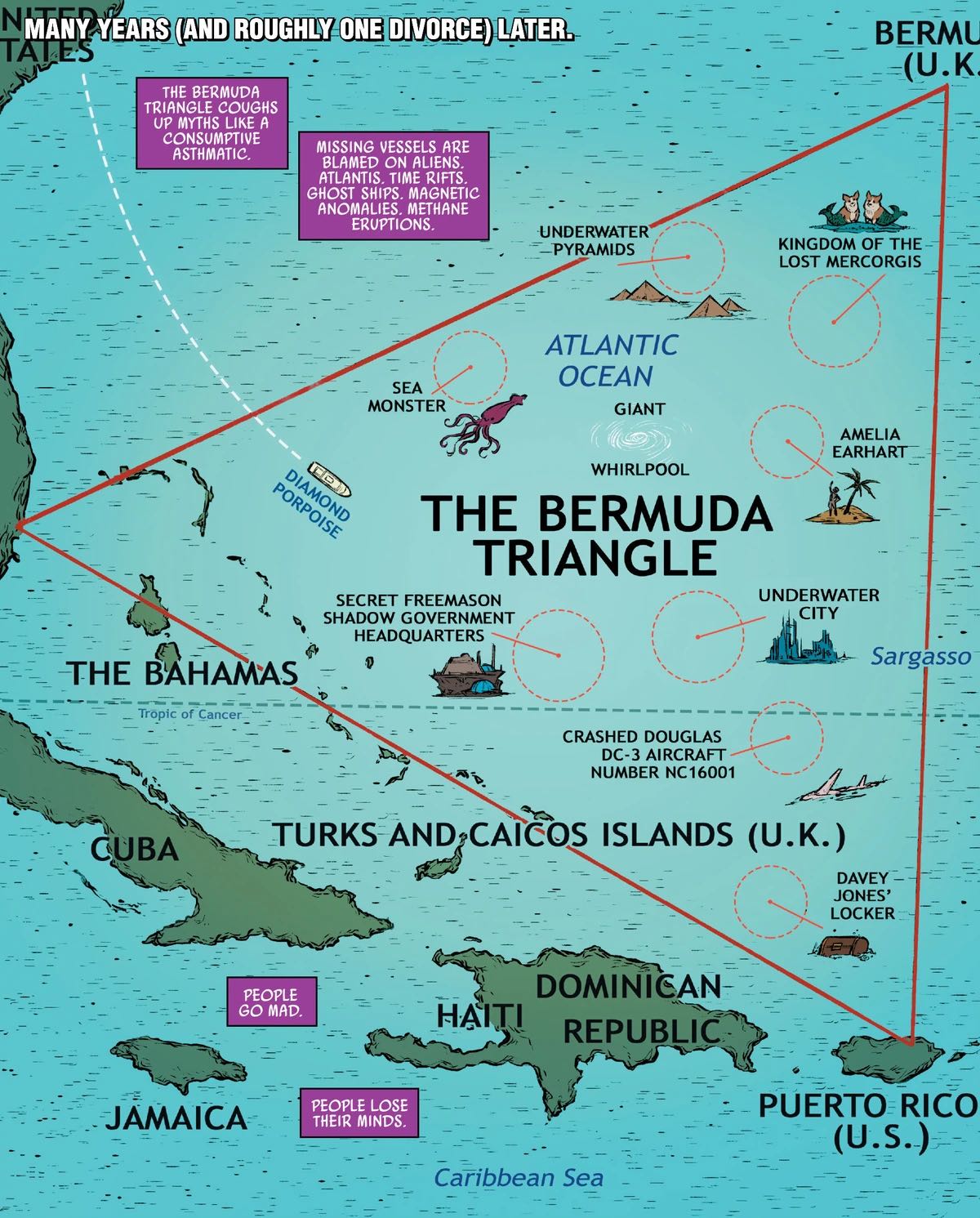
The Bermuda Triangle (also called the Devil’s Triangle) is a loosely defined region in the western part of the North Atlantic Ocean. It’s roughly bounded by three points:
• Miami (Florida, USA)
• Bermuda (a British Overseas Territory)
• San Juan (Puerto Rico)
The area forms a triangular shape, covering anywhere from about 500,000 to 1,500,000 square miles (estimates vary because the exact boundaries aren’t officially fixed).
Why is it famous?
Since the mid-20th century, it’s become legendary because dozens of ships (over 50 reported) and airplanes (around 20 ) are said to have disappeared mysteriously in this area, often without distress signals, wreckage, or clear explanation. Stories include sudden vanishings in calm weather, malfunctioning compasses, strange lights, and even time distortions.
The most famous case is Flight 19 in 1945: Five U.S. Navy bombers on a training flight vanished after the pilots reported compass problems and disorientation. A rescue plane sent after them also disappeared.
Books, movies, and media in the 1960s–1970s (like Vincent Gaddis’ article and Charles Berlitz’s book) popularized it as a supernatural hotspot, linking it to aliens, lost city of Atlantis, portals, sea monsters, or government experiments.
The scientific reality (and why it’s largely debunked)
Modern investigations by organizations like the U.S. Coast Guard, NOAA (National Oceanic and Atmospheric Administration), insurance companies (e.g., Lloyd’s of London), and scientists have found no evidence that the Bermuda Triangle is more dangerous than other busy ocean areas.
Key points from reliable sources (including updates through 2025–2026):
• Disappearances happen at a normal rate compared to similar high-traffic shipping and flying routes worldwide. The area is one of the busiest in the world, so more incidents are reported — but not unusually high when adjusted for traffic.
• Many famous stories were exaggerated, misreported, or fabricated. For example, some “missing” ships sank in storms far outside the Triangle, or incidents occurred in bad weather that was downplayed in sensational accounts (as shown in Larry Kusche’s 1975 book The Bermuda Triangle Mystery — Solved, still cited today).
• No unusual statistical anomaly exists — it’s a myth amplified by media and human love for mysteries.
Common scientific explanations for real incidents
Most cases have ordinary causes:
• Human error — Navigation mistakes, especially in the past before modern GPS.
• Bad weather — Sudden storms, waterspouts, or rogue waves (massive waves up to 100 feet / 30 meters high, formed when storms converge from different directions). Recent studies (e.g., by oceanographers like Dr. Simon Boxall in 2025 reports) highlight rogue waves as a likely cause for some sinkings.
• Compass issues — The area has an agonic line (where magnetic north and true north align), which can confuse old compasses if not adjusted for.
• Gulf Stream currents — Fast-moving water can quickly carry away debris, making wreckage hard to find.
• Methane gas hydrates (from the seafloor) — A theory, but no major releases have been confirmed in the Triangle in thousands of years.
• Shallow waters and reefs near islands add navigation hazards.
In short: The Bermuda Triangle is a real place, but the “mystery” is mostly an urban legend driven by sensationalism, not supernatural forces. Ships and planes pass through it safely every day.


Comments
This is amazing!
Where did you find this?